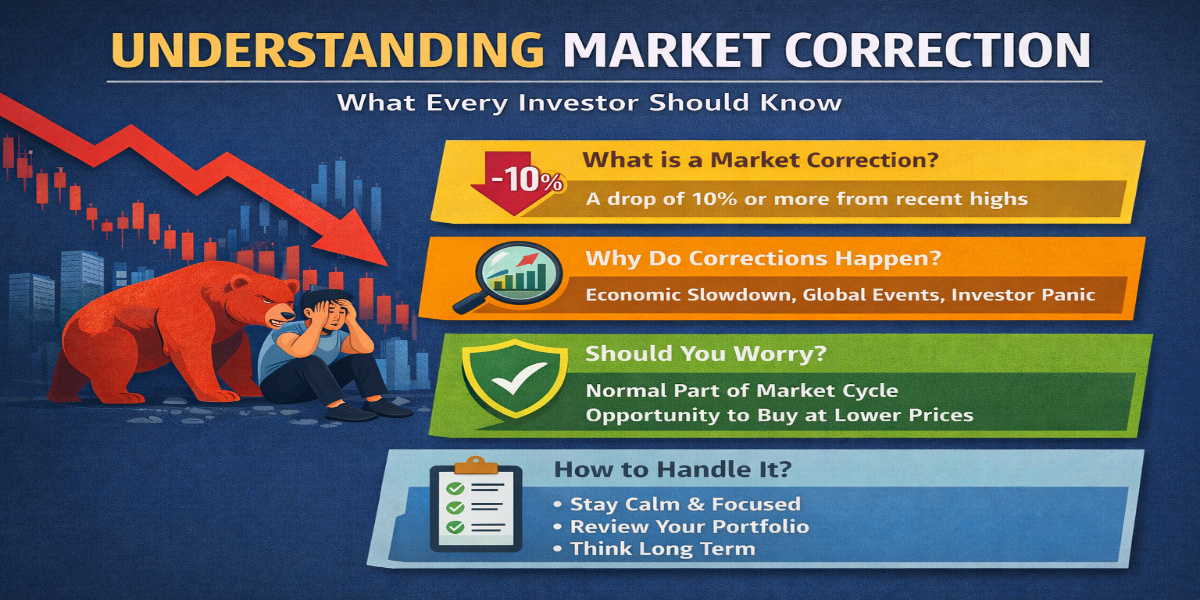
UNDERSTANDING MARKET CORRECTION | Omega Financial

01-Why you should read this before making any investment decision?

Dear Investor,

If you have been watching the markets over the past several months, you may be feeling a sense of unease. Your portfolio statement looks different from what it did a year ago. The financial news is full of words like “correction”, “sell-off”, and “uncertainty”. Friends and colleagues might be talking about exiting the market. And in quiet moments, you might be asking yourself: Should I be doing the same? 


We understand. These feelings are entirely natural, and you are not alone in experiencing them. But before you make any decision — before you pick up the phone to your mutual fund distributor or log into your investment app — we urge you to read this newsletter carefully and completely. Because what we are about to share with you is not opinion, not speculation, and not a sales pitch.


It is 35 years of hard data. And the data has a very clear, very consistent, and very reassuring message for you.

The central message of this Newsletter:

Every single correction the Nifty 50 has ever experienced — from a mild 5% dip to a catastrophic 60% crash — has been followed by a complete and full recovery. Not most of them. Not the majority. Every single one.

The current correction is not an exception to this rule. It is an example of it.

2. Where Does the Market Stand Today?

As of March 10, 2026, the Nifty 50 sits at 24,261. The index reached its most recent all-time high of 26,276 in January 2026. From the broader peak of 26,216 in September 2024, the index had fallen to a low of 22,083 in March 2025 — a decline of -15.8% over 159 trading days. It then recovered completely, hitting a new all-time high, before entering the current mild pullback.

Here is the snapshot of the current scenario:

24,261

As of Nifty Level (March 10, 2026)

Current

26,276

All-Time High


(Jan 2026)

Peak

-7.66%

Fall from Jan-26 peak

corrected & recovered

8.34%

Return Needed to Recover

From current level

The number that deserves your full attention is the last one: the Nifty only needs to rise 8.34% from current levels to reach a fresh all-time high again. That context alone should reframe how you are looking at the present situation.

3. Case Study: The Sep 2024 – Jan 2026 Correction

Let us examine the most recent major correction in detail. This is not ancient history — this happened in the last 18 months. Many of you lived through it and felt every twist and turn. Let us see what the data says.

The Investor Behaviour Gap — The Most Expensive Mistake:

An investor who sold at the March 2025 bottom (22,083) and re-entered at the January 2026 high (26,329) would have: locked in a -15.8% loss AND missed the +19.2% recovery. The total damage: roughly 35% underperformance versus doing absolutely nothing.

An investor who stayed invested saw their portfolio recover to new highs. An investor who increased SIPs or made a lump-sum top-up at the bottom earned exceptional returns.

4. 35 Years of Falls & Recoveries

As of March 10, 2026, the Nifty 50 sits at 24,261. The index reached its most recent all-time high of 26,329 in January. The following table is the most important thing you will read today. It covers every significant correction the Nifty 50 has experienced since January 1991 — spanning 35 years, multiple governments, global financial crises, pandemics, wars, and recessions. Study the last column. Not once not a single time — did the market fail to recover. Not even from a 60% crash.

Row highlighted in yellow = The Sep 2024–Jan 2026 correction. Now fully recovered. The final column shows how much the market gained from bottom to recovery peak.

5. Why Does the Market Always Recover?

A question we often hear from investors is: “Why should I believe the market will recover this time?” It is a fair question, and it deserves a serious answer. The recovery of equity markets is not luck or coincidence — it is driven by fundamental economic forces that do not change:

Corporate Earnings Growth The companies in the Nifty 50 are India’s largest and most resilient businesses — from banking and IT to consumer goods and energy. Over any 5-10 year period, their collective earnings have grown. As earnings grow, valuations recover and exceed previous peaks. A falling market does not change the underlying business model of Hindustan Unilever, HDFC Bank, or Reliance.

India’s Long-Term Economic Growth Story India is one of the world’s fastest growing major economies. Over the next decade, a young and growing workforce, rising middle class, increasing financial inclusion, and expanding digital infrastructure will continue to drive economic growth — and by extension, corporate earnings and equity returns.

Human Ingenuity and Adaptability Every crash in history was caused by a unique crisis — a pandemic, a financial collapse, a geopolitical shock. In each case, governments, businesses, and individuals adapted. Vaccines were developed. Stimulus was deployed. Business models evolved. The crisis that caused the fall was resolved, and the market moved on.

The Mathematics of Recovery When markets fall 15.8%, they only need to rise 18.8% to recover. When they fall 40%, they need 67% to recover. These numbers sound large — but over the timelines of actual recoveries, they have been achieved consistently. The engine of compounding always catches up.

6. Understanding the Psychology of Market Corrections

The greatest enemy of investment returns is not market volatility. It is investor behaviour. Research across decades and markets consistently shows that the average retail investor earns significantly less than the market returns — not because the market failed them, but because they bought at highs driven by greed and sold at lows driven by fear.

The Emotional Investment Cycle

What investors feel at the peak: Optimism → Excitement → Euphoria → Complacency —

“The market only goes up! Let me invest more!”

What investors feel during the fall: Anxiety → Denial → Panic → Capitulation — “I should have exited earlier! I need to sell now before I lose more!”

What investors feel during recovery: DepressionHope → ReliefOptimismThe market has recovered but should I trust it?

The tragic result: Many investors sell at the point of maximum fear (the bottom) — and buy again at the point of maximum optimism (near the peak). They buy high and sell low — the exact opposite of what creates wealth.

Recognising this pattern — and consciously choosing to act differently — is the single most impactful thing you can do for your long-term financial health. The data we have shown you in this newsletter is your antidote to fear. Every time you feel the urge to exit the market, return to the historical table in Section 4 and ask yourself: Did the market recover last time? And the time before that?

7. Your Action Plan: What to Do Right Now

Armed with this knowledge, here is your clear and evidence-based action plan for the current market environment:

Untitled design (2)
Untitled design (3)
8. The Power of SIPs During Market Corrections

If you are a SIP (Systematic Investment Plan) investor, market corrections are not your enemy — they are your opportunity. Here is why this is not just a platitude, but mathematical reality:

A Simple Example:

Suppose you invest ₹10,000 per month in an equity fund. At a NAV of ₹100, you get 100 units. If the NAV falls to ₹80 during a correction, your same ₹10,000 buys 125 units — 25 more units for the same money. When the market recovers to ₹110, your extra units have earned significantly more than if the correction had never happened.

This is called rupee cost averaging and it is the most powerful advantage the regular investor has over professional traders who must deploy large amounts at once. The correction does not hurt you; it helps you build more wealth at lower prices.

Every major fall in the Nifty 50’s history has been followed by a full recovery and new all-time highs. Each such recovery has rewarded disciplined SIP investors with disproportionately high returns — because they accumulated more units during the down phase. The September 2024 to January 2026 cycle is the most recent proof of this principle.


9. A Closing Message

We have walked you through the most recent correction step by step. We have explained the economic logic behind market recovery, the psychological traps that destroy wealth, and the concrete actions you should take.

The conclusion of all of this is simple: markets fall, and markets recover. That has been the unbroken pattern of the Nifty 50 since 1991, through every kind of crisis imaginable — including a global pandemic that shut down the entire world for months, a financial crisis that brought down some of the largest banks in history, and geopolitical conflicts that created immense uncertainty.

Remember the famous quote by Mr. Warren Buffett.

The stock market is a device for transferring money from the impatient to the patient.

Stay invested. Stay calm. Stay for long term.

Disclosure: Investment in the equity market and securities is subject to market risk; read all the scheme-related documents carefully before investing..

SOURCE: VALUE METRICS DISCLAIMER: Source: ACE MF, NSE. Any analysis/views expressed are meant for understanding a particular concept only. These analysis/views alone are not sufficient and should not be used for the developing or implementing an investment strategy. Investors should consult their financial advisors/mutual fund distributor if in doubt about whether the product is suitable for them. Past performance may or may not be sustained in future and is not a guarantee of any future returns. Index performance does not signify scheme performance.

Leave a Reply

Your email address will not be published. Required fields are marked *